
Blueprint: Deterministic AI – Nvidia PDFs Use Case
Blueprint: Deterministic AI – Nvidia PDFs Use Case

In my most recent articles and books, I discussed our radically different approach to building enterprise LLMs from scratch, without training, hallucinations, prompt engineering or GPU, while delivering higher accuracy at a much lower cost, safely, at scale and at lightning speed (in-memory). It is also far easier to adapt to specific corpuses and business needs, to fine-tune, and modify, giving you full control over all the components, based on a small number of intuitive parameters and explainable AI.
Download the full paper, here.
It has links to the sources including deep retrieval PDF parser, real-life input corpus, backend tables, and so on.
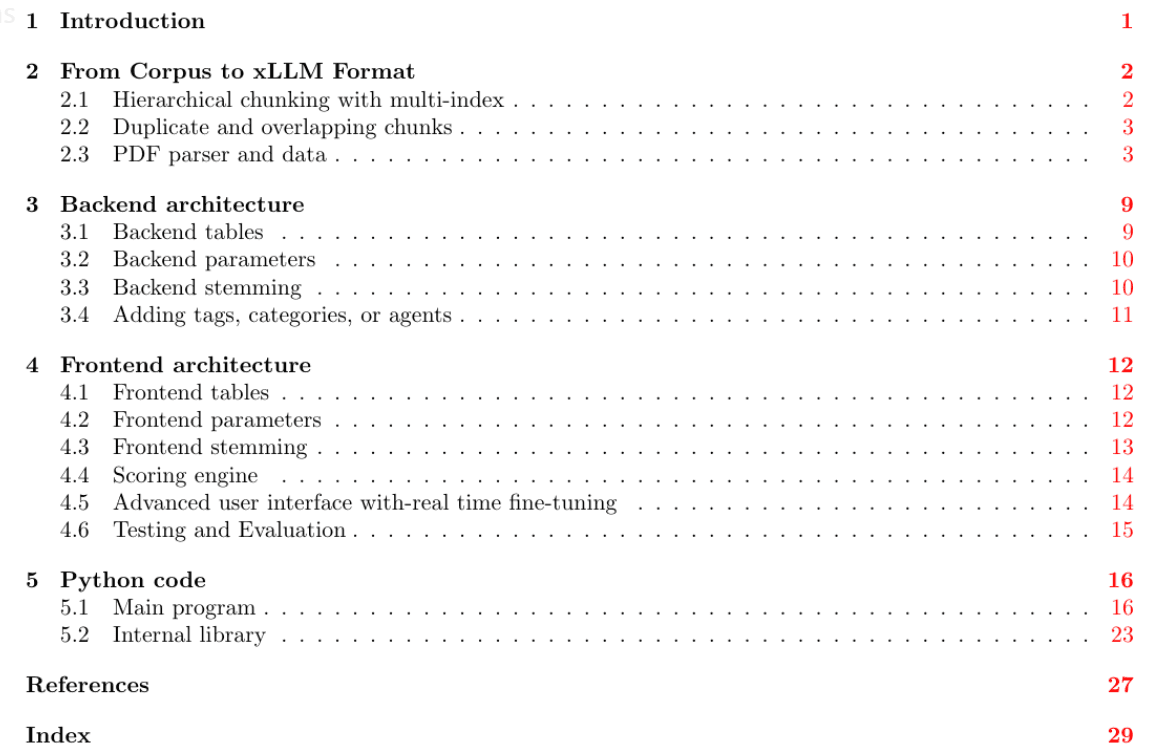
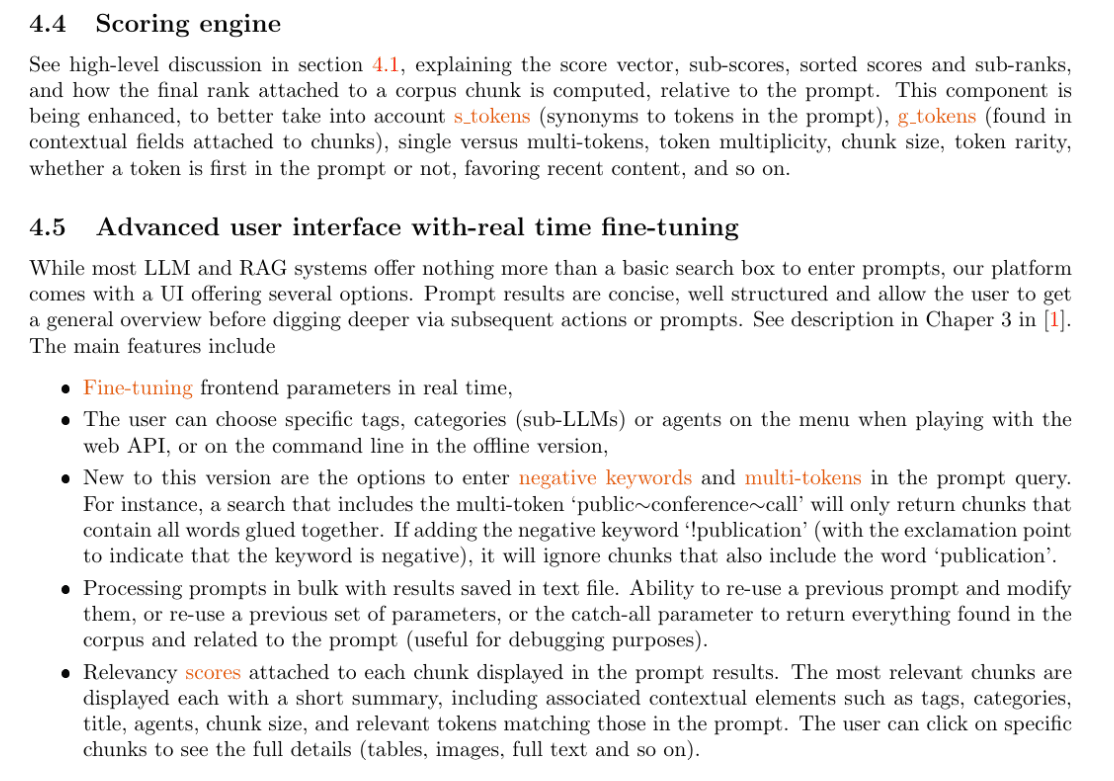
This technical paper is much more than a compact version of past documentation. It highlights new features such as un-stemming to boost exhaustivity, multi-index, relevancy score vectors, multi-level chunking, various multi-token types (some originating from the knowledge graph) and how they are leveraged, as well as pre-assigned multimodal agents. I also discuss the advanced UI — far more than a prompt box — with unaltered concise structured output, suggested keywords for deeper dive, agent or category selection to increase focus, and relevancy scores. Of special interest: simplified, improved architecture, and upgrade to process word associations in large chunks (embeddings) even faster.
In my most recent articles and books, I discussed our radically different approach to building enterprise LLMs from scratch, without training, hallucinations, prompt engineering or GPU, while delivering higher accuracy at a much lower cost, safely, at scale and at lightning speed (in-memory). It is also far easier to adapt to specific corpuses and business needs, to fine-tune, and modify, giving you full control over all the components, based on a small number of intuitive parameters and explainable AI.
Download the full paper, here.
It has links to the sources including deep retrieval PDF parser, real-life input corpus, backend tables, and so on.
This technical paper is much more than a compact version of past documentation. It highlights new features such as un-stemming to boost exhaustivity, multi-index, relevancy score vectors, multi-level chunking, various multi-token types (some originating from the knowledge graph) and how they are leveraged, as well as pre-assigned multimodal agents. I also discuss the advanced UI — far more than a prompt box — with unaltered concise structured output, suggested keywords for deeper dive, agent or category selection to increase focus, and relevancy scores. Of special interest: simplified, improved architecture, and upgrade to process word associations in large chunks (embeddings) even faster.
About the Author

Vincent Granville is a pioneering GenAI scientist, co-founder at BondingAI.io, the LLM 2.0 platform for hallucination-free, secure, in-house, lightning-fast Enterprise AI at scale with zero weight and no GPU. He is also author (Elsevier, Wiley), publisher, and successful entrepreneur with multi-million-dollar exit. Vincent’s past corporate experience includes Visa, Wells Fargo, eBay, NBC, Microsoft, and CNET. He completed a post-doc in computational statistics at University of Cambridge.
Vincent Granville is a pioneering GenAI scientist, co-founder at BondingAI.io, the LLM 2.0 platform for hallucination-free, secure, in-house, lightning-fast Enterprise AI at scale with zero weight and no GPU. He is also author (Elsevier, Wiley), publisher, and successful entrepreneur with multi-million-dollar exit. Vincent’s past corporate experience includes Visa, Wells Fargo, eBay, NBC, Microsoft, and CNET. He completed a post-doc in computational statistics at University of Cambridge.
More enterprise AI insights
More enterprise AI insights
Stay informed. Leave your email to receive exclusive content and helpful resources.
Stay informed. Leave your email to receive exclusive content and helpful resources.
Recent Articles
Recent Articles

LLM Explainability: How Tokenization Limits AI Traceability
LLM Explainability: How Tokenization Limits AI Traceability
LLM Explainability: How Tokenization Limits AI Traceability

AI Sprawl: Why Most Companies Can't See What Their AI Does
AI Sprawl: Why Most Companies Can't See What Their AI Does
AI Sprawl: Why Most Companies Can't See What Their AI Does

Enterprise AI Costs: Why Companies Are Paying Twice
Enterprise AI Costs: Why Companies Are Paying Twice
Enterprise AI Costs: Why Companies Are Paying Twice

Numbers Every CISO Should Know Before the Next AI Deployment
Numbers Every CISO Should Know Before the Next AI Deployment
Numbers Every CISO Should Know Before the Next AI Deployment

AI Myths Enterprise Leaders Still Believe
AI Myths Enterprise Leaders Still Believe
AI Myths Enterprise Leaders Still Believe

Numbers Every CRO Should Know
Numbers Every CRO Should Know
Numbers Every CRO Should Know

The AI Operating System for Enterprises
300 Davis St, McKinney, TX 75069 - U.S.
© 2026 Copyright - bondingAI.
The AI Operating System for Enterprises
300 Davis St, McKinney, TX 75069 - U.S.
© 2026 Copyright - bondingAI.
The AI Operating System for Enterprises
300 Davis St, McKinney, TX 75069 - U.S.
© 2026 Copyright - bondingAI.
The AI Operating System for Enterprises
300 Davis St, McKinney, TX 75069 - U.S.
© 2026 Copyright - bondingAI.