
Numbers Every CRO Should Know
Numbers Every CRO Should Know

Every CRO knows the feeling: the forecast looks fine, until it doesn't. A deal that was “commit” slips in the last week of the quarter. A rep's confidence turns out to have been optimism, not signal. And by the time the number is wrong, it's too late to do anything about it.
That feeling isn't a leadership failure. It's a systems failure. The CRM was built to record what happened in the sales process, not to guide what should happen next. Three statistics show just how wide that gap has become, and why closing it is now one of the defining questions for revenue leaders.
7%: the forecast accuracy problem.
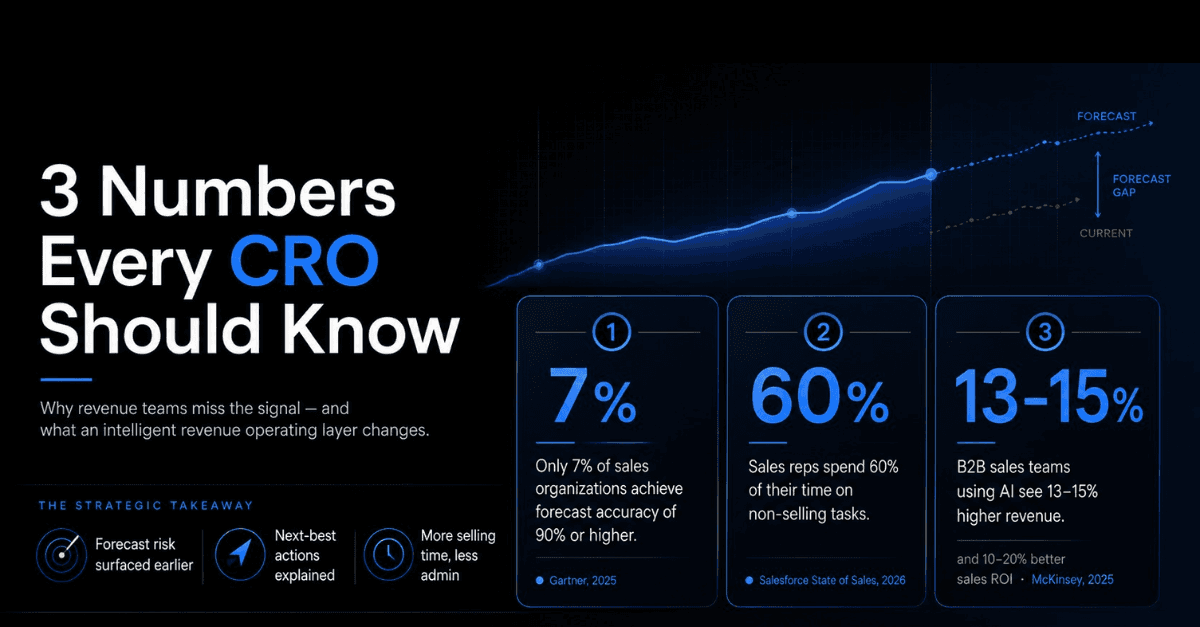
Only 7% of sales organizations achieve forecast accuracy of 90% or higher. The other 93% are running the business on confidence, not data. (Source: Gartner, 2025)
That statistic is worth sitting with. Forecast accuracy isn't a vanity metric for the sales team; it's an input that ripples through the entire business. Finance builds budgets on it. Operations plans headcount and capacity around it. The board sets expectations with the market based on it. When forecast accuracy is this rare, the problem isn't that reps are bad at their jobs. It's that most revenue organizations still forecast the way they did a decade ago: rep intuition, rolled up through managers, checked against a pipeline view that shows stage and amount but not risk.
A CRM can tell a CRO how many deals are in “negotiation.” It can't tell them which of those deals are actually at risk of slipping, and why. That distinction is exactly where forecast accuracy is won or lost.
60%: where sales time actually goes.
Sales reps spend 60% of their time on non-selling tasks, including CRM updates, admin work and internal meetings, while the pipeline moves slower than the market does. (Source: Salesforce, State of Sales, 2026, citing Gartner Sales Survey)
This is the number that should make every CRO pause when they look at quota attainment. It means the average rep is doing the job of selling in less than half of their working week. The rest goes to logging what already happened: updating fields, writing call notes, preparing internal updates, sitting in meetings about the pipeline instead of moving it forward.
None of that work is optional today, because the data has to live somewhere and leadership needs visibility. But it is exactly the kind of work that a system built to understand revenue operations, rather than just record them, should be absorbing on the rep's behalf. Every hour reclaimed from admin is an hour that goes back into the pipeline.
13–15%: the return on getting it right.
B2B sales teams using AI see 13–15% higher revenue and 10–20% better sales ROI. Same reps, same pipeline, same market: the difference is what's guiding the next move. (Source: McKinsey, 2025)
This is the number that reframes the first two. Low forecast accuracy and low selling time aren't fixed costs of running a sales organization; they are the gap that better guidance closes. The teams outperforming their peers aren't working harder or carrying bigger headcount. They are spending less time deciding what to do next, because the system is doing more of that thinking for them, and doing it in a way reps and managers can actually trust.
The system of record was never the problem.
CRMs store what happened. They don't tell you what to do next. Traditional CRM is a system of record: it logs the deal, but it doesn't flag the risk, recommend the next action, or explain why a forecast should be trusted. That was never a flaw in the CRM. It's simply what a system of record is built to do.
The problem is that revenue teams have been asking the CRM to do a job it was never designed for: tell them what's about to happen, not just what already did. Layering more dashboards and more reports on top of the same underlying data doesn't solve that. It just makes the system of record easier to look at, not easier to act on.
Enterprise AI needs to do more than store data. It needs to understand revenue operations, prioritize action, explain its reasoning, and orchestrate execution across the systems reps and managers already work in. That is the layer bondingAI was built for: transforming disconnected sales systems into one intelligent revenue operating layer.
One AI Operating System for revenue that CROs can actually trust:
bondingAI connects CRM, ERP, email and enterprise knowledge into a single intelligent revenue layer, sitting across the systems that already hold the truth about a deal instead of asking teams to adopt yet another tool.
From that layer, it recommends the next-best action explainably, so a rep or manager can see the reasoning behind a recommendation rather than taking it on faith. It increases forecast confidence by surfacing risk earlier, before a deal quietly slips from commit to closed-lost. And it accelerates sales cycles by giving reps back the time currently lost to admin, redirecting it toward the conversations that actually move revenue.
For a CRO, that adds up to a system built to guide decisions, not just record them, an operating layer that closes the gap between what the CRM shows and what the business actually needs to know.
Stop managing revenue. Start operating it intelligently.
Every CRO knows the feeling: the forecast looks fine, until it doesn't. A deal that was “commit” slips in the last week of the quarter. A rep's confidence turns out to have been optimism, not signal. And by the time the number is wrong, it's too late to do anything about it.
That feeling isn't a leadership failure. It's a systems failure. The CRM was built to record what happened in the sales process, not to guide what should happen next. Three statistics show just how wide that gap has become, and why closing it is now one of the defining questions for revenue leaders.
7%: the forecast accuracy problem.
Only 7% of sales organizations achieve forecast accuracy of 90% or higher. The other 93% are running the business on confidence, not data. (Source: Gartner, 2025)
That statistic is worth sitting with. Forecast accuracy isn't a vanity metric for the sales team; it's an input that ripples through the entire business. Finance builds budgets on it. Operations plans headcount and capacity around it. The board sets expectations with the market based on it. When forecast accuracy is this rare, the problem isn't that reps are bad at their jobs. It's that most revenue organizations still forecast the way they did a decade ago: rep intuition, rolled up through managers, checked against a pipeline view that shows stage and amount but not risk.
A CRM can tell a CRO how many deals are in “negotiation.” It can't tell them which of those deals are actually at risk of slipping, and why. That distinction is exactly where forecast accuracy is won or lost.
60%: where sales time actually goes.
Sales reps spend 60% of their time on non-selling tasks, including CRM updates, admin work and internal meetings, while the pipeline moves slower than the market does. (Source: Salesforce, State of Sales, 2026, citing Gartner Sales Survey)
This is the number that should make every CRO pause when they look at quota attainment. It means the average rep is doing the job of selling in less than half of their working week. The rest goes to logging what already happened: updating fields, writing call notes, preparing internal updates, sitting in meetings about the pipeline instead of moving it forward.
None of that work is optional today, because the data has to live somewhere and leadership needs visibility. But it is exactly the kind of work that a system built to understand revenue operations, rather than just record them, should be absorbing on the rep's behalf. Every hour reclaimed from admin is an hour that goes back into the pipeline.
13–15%: the return on getting it right.
B2B sales teams using AI see 13–15% higher revenue and 10–20% better sales ROI. Same reps, same pipeline, same market: the difference is what's guiding the next move. (Source: McKinsey, 2025)
This is the number that reframes the first two. Low forecast accuracy and low selling time aren't fixed costs of running a sales organization; they are the gap that better guidance closes. The teams outperforming their peers aren't working harder or carrying bigger headcount. They are spending less time deciding what to do next, because the system is doing more of that thinking for them, and doing it in a way reps and managers can actually trust.
The system of record was never the problem.
CRMs store what happened. They don't tell you what to do next. Traditional CRM is a system of record: it logs the deal, but it doesn't flag the risk, recommend the next action, or explain why a forecast should be trusted. That was never a flaw in the CRM. It's simply what a system of record is built to do.
The problem is that revenue teams have been asking the CRM to do a job it was never designed for: tell them what's about to happen, not just what already did. Layering more dashboards and more reports on top of the same underlying data doesn't solve that. It just makes the system of record easier to look at, not easier to act on.
Enterprise AI needs to do more than store data. It needs to understand revenue operations, prioritize action, explain its reasoning, and orchestrate execution across the systems reps and managers already work in. That is the layer bondingAI was built for: transforming disconnected sales systems into one intelligent revenue operating layer.
One AI Operating System for revenue that CROs can actually trust:
bondingAI connects CRM, ERP, email and enterprise knowledge into a single intelligent revenue layer, sitting across the systems that already hold the truth about a deal instead of asking teams to adopt yet another tool.
From that layer, it recommends the next-best action explainably, so a rep or manager can see the reasoning behind a recommendation rather than taking it on faith. It increases forecast confidence by surfacing risk earlier, before a deal quietly slips from commit to closed-lost. And it accelerates sales cycles by giving reps back the time currently lost to admin, redirecting it toward the conversations that actually move revenue.
For a CRO, that adds up to a system built to guide decisions, not just record them, an operating layer that closes the gap between what the CRM shows and what the business actually needs to know.
Stop managing revenue. Start operating it intelligently.
More enterprise AI insights
More enterprise AI insights
Stay informed. Leave your email to receive exclusive content and helpful resources.
Stay informed. Leave your email to receive exclusive content and helpful resources.
Recent Articles
Recent Articles

AI Sprawl: Why Most Companies Can't See What Their AI Does
AI Sprawl: Why Most Companies Can't See What Their AI Does
AI Sprawl: Why Most Companies Can't See What Their AI Does

Enterprise AI Costs: Why Companies Are Paying Twice
Enterprise AI Costs: Why Companies Are Paying Twice
Enterprise AI Costs: Why Companies Are Paying Twice

Numbers Every CISO Should Know Before the Next AI Deployment
Numbers Every CISO Should Know Before the Next AI Deployment
Numbers Every CISO Should Know Before the Next AI Deployment

AI Myths Enterprise Leaders Still Believe
AI Myths Enterprise Leaders Still Believe
AI Myths Enterprise Leaders Still Believe

Why Generic AI Tools Don't Understand Your Business
Why Generic AI Tools Don't Understand Your Business
Why Generic AI Tools Don't Understand Your Business

Operational Numbers Every COO Should Know
Operational Numbers Every COO Should Know
Operational Numbers Every COO Should Know

The AI Operating System for Enterprises
300 Davis St, McKinney, TX 75069 - U.S.
© 2026 Copyright - bondingAI.
The AI Operating System for Enterprises
300 Davis St, McKinney, TX 75069 - U.S.
© 2026 Copyright - bondingAI.
The AI Operating System for Enterprises
300 Davis St, McKinney, TX 75069 - U.S.
© 2026 Copyright - bondingAI.
The AI Operating System for Enterprises
300 Davis St, McKinney, TX 75069 - U.S.
© 2026 Copyright - bondingAI.