
Enterprise AI Costs: Why Companies Are Paying Twice
Enterprise AI Costs: Why Companies Are Paying Twice

Enterprises Are Paying for AI Twice
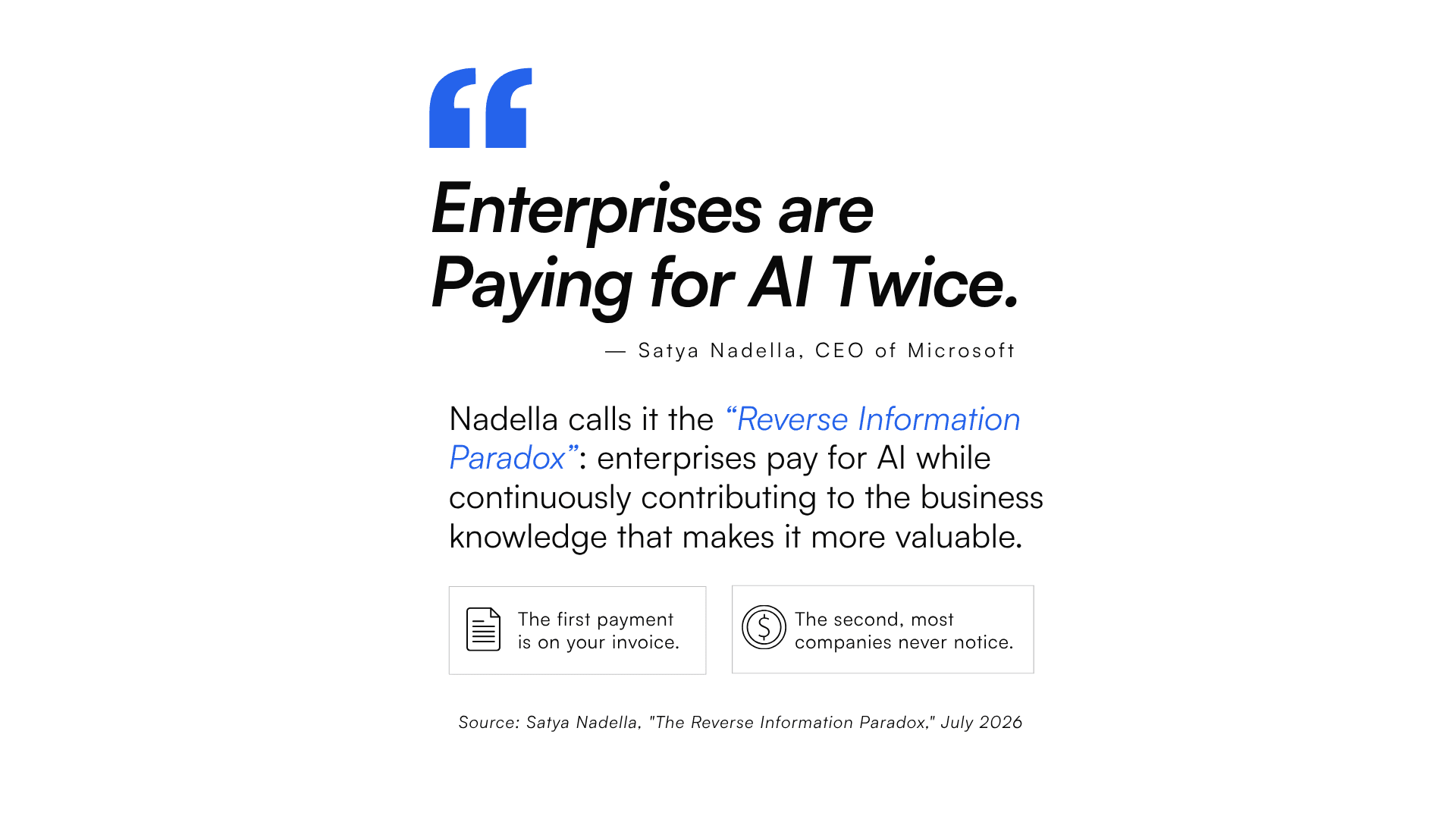
That's not a marketing line. It's Microsoft CEO Satya Nadella, describing what he calls the “Reverse Information Paradox.” The first payment shows up on the invoice. The second, most companies never notice.
Every enterprise rolling out generative AI has gotten comfortable talking about the first payment: the line items on the invoice. Far fewer have stopped to ask what the second one costs, or where it shows up. Nadella's framing gives that hidden cost a name, and it's worth walking through both payments in order, because the second one is the one that most enterprise AI strategies are built to ignore.
What You Know You're Paying For:
The visible cost of enterprise AI is easy to notice. Subscriptions become recurring enterprise spend, renewed year over year regardless of whether the tool is delivering. Copilots are licensed seat by seat, so the bill scales with headcount rather than with outcomes. API calls and inference costs scale with adoption, which sounds healthy until adoption itself becomes the expense, not the payoff. And token spend grows alongside usage, but it comes with no guaranteed return; the more a team relies on the model, the larger the invoice, with no built-in mechanism that ties that spend back to measurable value.
That last point isn't a hypothetical risk. According to MIT NANDA's “The GenAI Divide: State of AI in Business” (2025), 95% of enterprise generative AI pilots fail to deliver measurable financial return. That statistic captures something important: enterprises are not struggling to adopt AI,
they're struggling to make adoption pay for itself.
Intelligence you rent doesn't automatically become value you keep, no matter how much of it you rent.
The Hidden Invoice:
There is a second cost that rarely appears on any budget line, because no one sends an invoice for it. Every prompt teaches the model something about your business. Nadella calls this “intelligence exhaust”: the terminology, the policies, the workflows, and the corrections your team feeds an AI model every day just to get it to produce something useful. As he put it, “In consuming intelligence, you are creating intelligence.” The exhaust is real intelligence, generated by real employees, on the enterprise's time.
The trouble is where that intelligence goes. In practice, employees re-explain the same processes week after week, because the model has no durable memory of the correction it received last time. Institutional knowledge leaks out, prompt by prompt, in exchanges that are never captured, structured, or returned to the business as something reusable.
None of it comes back as organizational intelligence the company can build on. The company relearns what it already knew, on repeat, paying the same teaching cost over and over. The knowledge doesn't disappear. It just stops belonging to you.
The Compounding Cost:
Without the right infrastructure, every prompt starts from zero, and that isn't a minor inefficiency, it's a structural ceiling on what the technology can return. That fragility has a price at the portfolio level, too: Gartner projects that more than 40% of agentic AI projects will be canceled by the end of 2027, due to escalating costs, unclear business value, or inadequate risk controls.
Projects that can't demonstrate value or can't be governed don't survive their second budget cycle.
The pattern behind that number is consistent across the enterprises it will touch. With no memory, every interaction starts over, so the model never gets faster or sharper at your business specifically, only at generic tasks. With no governance, there is no traceable decision trail, which means no one can audit why an agent did what it did, and no one can trust it with more autonomy as a result. With nothing compounding, knowledge stays fragmented across tools, teams, and sessions instead of accumulating into something the enterprise can point to and defend. And with no ownership, enterprises keep paying without ever building an asset; the spend never converts into anything that shows up on the balance sheet.
The enterprise AI advantage comes from turning proprietary data and business knowledge into intelligence the company owns and controls.
The first payment is the invoice. The second is your knowledge. bondingAI is built so only the first one leaves your walls.
Stop renting intelligence. Start owning it.
Without the right infrastructure, knowledge leaks out with every prompt, the AI never learns the business in real depth, there is no audit trail or explainability behind its decisions, and enterprises end up paying twice: once in cost, and again in what they give away. That's the equation most generative AI deployments are running today, whether or not the enterprise has named it.
bondingAI is built to change that equation from the ground up. At its core is xLLM, The Nest-Generation Enterprise Language Model, that makes intelligence something your company owns rather than rents, so the knowledge generated inside your organization stays inside your organization.
It operates deterministically and transparently, so every output is traceable to its source rather than treated as a black box the business has to trust blindly. It connects to enterprise data, rules, and workflows, so knowledge compounds instead of resetting with every interaction, and each correction your team makes today makes the system sharper tomorrow. And it keeps a human in the loop, so agents act inside your guardrails rather than around them, giving the enterprise a governed path to autonomy instead of an ungoverned one.
Put together, these capabilities turn AI from a recurring expense into a compounding asset.
Every prompt that would have leaked out as exhaust instead becomes structured, owned knowledge. Every workflow the system learns, makes the next one faster and more accurate, rather than starting from the same blank slate. And every decision the system makes carries the explainability an enterprise needs to trust it with more responsibility over time.
bondingAI isn't another AI tool. It's the infrastructure layer that makes sure the intelligence you build stays yours.
See how bondingAI turns AI spend into an owned enterprise asset.
Enterprises Are Paying for AI Twice
That's not a marketing line. It's Microsoft CEO Satya Nadella, describing what he calls the “Reverse Information Paradox.” The first payment shows up on the invoice. The second, most companies never notice.
Every enterprise rolling out generative AI has gotten comfortable talking about the first payment: the line items on the invoice. Far fewer have stopped to ask what the second one costs, or where it shows up. Nadella's framing gives that hidden cost a name, and it's worth walking through both payments in order, because the second one is the one that most enterprise AI strategies are built to ignore.
What You Know You're Paying For:
The visible cost of enterprise AI is easy to notice. Subscriptions become recurring enterprise spend, renewed year over year regardless of whether the tool is delivering. Copilots are licensed seat by seat, so the bill scales with headcount rather than with outcomes. API calls and inference costs scale with adoption, which sounds healthy until adoption itself becomes the expense, not the payoff. And token spend grows alongside usage, but it comes with no guaranteed return; the more a team relies on the model, the larger the invoice, with no built-in mechanism that ties that spend back to measurable value.
That last point isn't a hypothetical risk. According to MIT NANDA's “The GenAI Divide: State of AI in Business” (2025), 95% of enterprise generative AI pilots fail to deliver measurable financial return. That statistic captures something important: enterprises are not struggling to adopt AI,
they're struggling to make adoption pay for itself.
Intelligence you rent doesn't automatically become value you keep, no matter how much of it you rent.
The Hidden Invoice:
There is a second cost that rarely appears on any budget line, because no one sends an invoice for it. Every prompt teaches the model something about your business. Nadella calls this “intelligence exhaust”: the terminology, the policies, the workflows, and the corrections your team feeds an AI model every day just to get it to produce something useful. As he put it, “In consuming intelligence, you are creating intelligence.” The exhaust is real intelligence, generated by real employees, on the enterprise's time.
The trouble is where that intelligence goes. In practice, employees re-explain the same processes week after week, because the model has no durable memory of the correction it received last time. Institutional knowledge leaks out, prompt by prompt, in exchanges that are never captured, structured, or returned to the business as something reusable.
None of it comes back as organizational intelligence the company can build on. The company relearns what it already knew, on repeat, paying the same teaching cost over and over. The knowledge doesn't disappear. It just stops belonging to you.
The Compounding Cost:
Without the right infrastructure, every prompt starts from zero, and that isn't a minor inefficiency, it's a structural ceiling on what the technology can return. That fragility has a price at the portfolio level, too: Gartner projects that more than 40% of agentic AI projects will be canceled by the end of 2027, due to escalating costs, unclear business value, or inadequate risk controls.
Projects that can't demonstrate value or can't be governed don't survive their second budget cycle.
The pattern behind that number is consistent across the enterprises it will touch. With no memory, every interaction starts over, so the model never gets faster or sharper at your business specifically, only at generic tasks. With no governance, there is no traceable decision trail, which means no one can audit why an agent did what it did, and no one can trust it with more autonomy as a result. With nothing compounding, knowledge stays fragmented across tools, teams, and sessions instead of accumulating into something the enterprise can point to and defend. And with no ownership, enterprises keep paying without ever building an asset; the spend never converts into anything that shows up on the balance sheet.
The enterprise AI advantage comes from turning proprietary data and business knowledge into intelligence the company owns and controls.
The first payment is the invoice. The second is your knowledge. bondingAI is built so only the first one leaves your walls.
Stop renting intelligence. Start owning it.
Without the right infrastructure, knowledge leaks out with every prompt, the AI never learns the business in real depth, there is no audit trail or explainability behind its decisions, and enterprises end up paying twice: once in cost, and again in what they give away. That's the equation most generative AI deployments are running today, whether or not the enterprise has named it.
bondingAI is built to change that equation from the ground up. At its core is xLLM, The Nest-Generation Enterprise Language Model, that makes intelligence something your company owns rather than rents, so the knowledge generated inside your organization stays inside your organization.
It operates deterministically and transparently, so every output is traceable to its source rather than treated as a black box the business has to trust blindly. It connects to enterprise data, rules, and workflows, so knowledge compounds instead of resetting with every interaction, and each correction your team makes today makes the system sharper tomorrow. And it keeps a human in the loop, so agents act inside your guardrails rather than around them, giving the enterprise a governed path to autonomy instead of an ungoverned one.
Put together, these capabilities turn AI from a recurring expense into a compounding asset.
Every prompt that would have leaked out as exhaust instead becomes structured, owned knowledge. Every workflow the system learns, makes the next one faster and more accurate, rather than starting from the same blank slate. And every decision the system makes carries the explainability an enterprise needs to trust it with more responsibility over time.
bondingAI isn't another AI tool. It's the infrastructure layer that makes sure the intelligence you build stays yours.
See how bondingAI turns AI spend into an owned enterprise asset.
More enterprise AI insights
More enterprise AI insights
Stay informed. Leave your email to receive exclusive content and helpful resources.
Stay informed. Leave your email to receive exclusive content and helpful resources.
Recent Articles
Recent Articles

AI Token Costs: Context Windows, Pricing and Audit Trails
AI Token Costs: Context Windows, Pricing and Audit Trails
AI Token Costs: Context Windows, Pricing and Audit Trails

LLM Explainability: How Tokenization Limits AI Traceability
LLM Explainability: How Tokenization Limits AI Traceability
LLM Explainability: How Tokenization Limits AI Traceability

AI Sprawl: Why Most Companies Can't See What Their AI Does
AI Sprawl: Why Most Companies Can't See What Their AI Does
AI Sprawl: Why Most Companies Can't See What Their AI Does

Numbers Every CISO Should Know Before the Next AI Deployment
Numbers Every CISO Should Know Before the Next AI Deployment
Numbers Every CISO Should Know Before the Next AI Deployment

AI Myths Enterprise Leaders Still Believe
AI Myths Enterprise Leaders Still Believe
AI Myths Enterprise Leaders Still Believe

Numbers Every CRO Should Know
Numbers Every CRO Should Know
Numbers Every CRO Should Know

The AI Operating System for Enterprises
300 Davis St, McKinney, TX 75069 - U.S.
© 2026 Copyright - bondingAI.
The AI Operating System for Enterprises
300 Davis St, McKinney, TX 75069 - U.S.
© 2026 Copyright - bondingAI.
The AI Operating System for Enterprises
300 Davis St, McKinney, TX 75069 - U.S.
© 2026 Copyright - bondingAI.
The AI Operating System for Enterprises
300 Davis St, McKinney, TX 75069 - U.S.
© 2026 Copyright - bondingAI.