
AI Sprawl: Why Most Companies Can't See What Their AI Does
AI Sprawl: Why Most Companies Can't See What Their AI Does

Most Companies Already Have AI. Fewer Know What It's Doing.
Walk into almost any large company today and you'll find AI in use somewhere: a chat assistant in one team, a copilot inside the office suite, a model someone connected to a spreadsheet last quarter. Ask who approved each of those, what data they can read, and how much they cost per month, and you'll usually get a few different answers, or none.
That's a natural result of how quickly AI arrived and how easy it was to start using. It has also left many organizations with a lot of activity and very little visibility, and the numbers show it.
More AI, Not Much More Impact
In McKinsey's 2026 global survey of 1,719 respondents, 56% say their organizations use AI in three or more business functions, and 44% report AI scaling across the enterprise. Only 37% attribute any EBIT impact to AI, essentially unchanged from 2025. About one in five say AI operating costs, including token costs, have already constrained how much they use it.
So companies are using AI in more places, paying for it, and in many cases not seeing it show up in results. A large part of the reason is that no one can see the whole picture. In a 2026 Dataiku/Harris Poll survey of 600 enterprise CIOs, 82% agreed that employees are creating AI agents and apps faster than IT can govern them, and 54% had already discovered unsanctioned AI use.
What Is AI Sprawl?
AI sprawl is the unplanned accumulation of AI tools, models, and agents across a company, each with its own permissions, logs, and billing. Shadow AI, meaning tools adopted without IT's knowledge, is one part of it. Much of the sprawl is sanctioned: tools approved one at a time and never designed to work under a common set of rules.
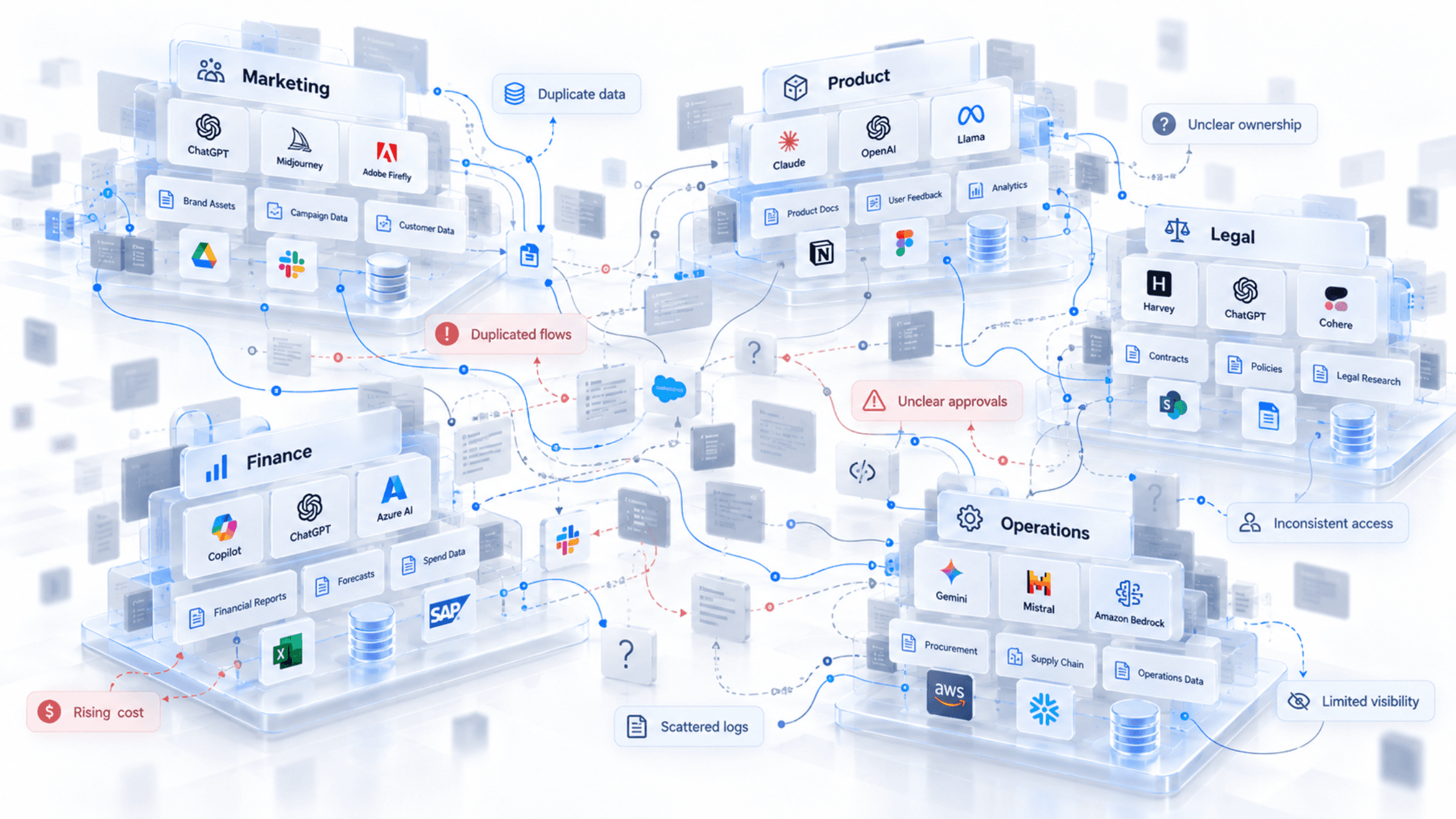
Very few companies sat down and designed their AI environment. It grew. A team picked a chat tool, another signed up for an AI SaaS product, IT connected an API from one model provider and later another, someone built a retrieval pipeline over the knowledge base, and a different team built a second one over mostly the same documents. Add open-source models, vector databases, agent frameworks, and cloud AI services, and you have a dozen pieces that each follow their own rules.
Day to day, AI sprawl shows up in small, irritating ways:
The same document is open to one tool and locked in another.
Two colleagues ask the same question and get different answers, depending on where they asked.
Finance can't forecast the AI bill, because part of it is per token and part of it is per seat. (More on that in why enterprises end up paying twice for AI.)
When someone asks why an answer came out the way it did, nobody can say which model, data, and prompt were behind it.
When the business wants AI to do something in the ERP or CRM, there's no shared place to set the rules for it.
How Do You Govern AI Once It Can Act?
Answering is one thing. Acting is another, and more companies are heading there. Among organizations with more than $1 billion in revenue, the share scaling AI agents rose from 27% to 40% in one year, according to McKinsey. Gartner predicts that more than 40% of agentic AI projects will be canceled by the end of 2027, citing escalating costs, unclear business value, and inadequate risk controls.
Security data shows where sprawl creates the most exposure. IBM's 2026 Cost of a Data Breach Report found that more than 20% of organizations reported a breach targeting AI models or applications. The most common causes were compromised APIs, applications, or plug-ins (27%) and cloud misconfigurations affecting AI workloads (27%). The trouble tends to start in the connections between AI and everything else the company runs, which is exactly where sprawl multiplies. For the security side of this, see the numbers every CISO should know before the next AI deployment.
7 Questions to Bring AI Sprawl Under Control
Start with an honest inventory. For every AI use case in the company, try to answer these seven questions:
What AI is running today, and who owns each piece?
Which data can each tool, model, and agent reach?
Who is allowed to use it, and who approved that access?
What can it change in business systems such as the ERP or CRM?
Who signs off before it acts?
Can you trace any answer or action back to the model, data, and prompt behind it?
What will it cost next quarter if usage doubles?
If you can answer all seven everywhere, you're in good shape. If you can answer them for some use cases and not others, that's the gap to close.
Closing it tool by tool rarely holds, because each tool keeps its own rules. The durable fix is one control layer above the models that applies the same permissions, policies, and audit trail every time AI runs. That layer is what an enterprise AI Operating System provides.
Why Do Clear Rules Make It Easier to Experiment?
Clear permissions let teams experiment with a limited downside. Harvard Business School professor Amy Edmondson's work on "intelligent failures" holds that the most valuable experiments are the ones whose downside is deliberately kept small. Clear permissions do that for AI. A team can try a new model, agent, or workflow knowing that sensitive data and core systems sit outside its reach. When something goes wrong, the audit trail shows what happened, and the next attempt starts from better information.
Where bondingAI Fits
bondingAI built its AI Operating System (AIOS) for this problem. It sits above your models, data, and business systems and puts them under a single set of rules. Every request follows the same three steps, Ask, Analyze, Act, and at each step the same permissions, policies, and audit trail apply.

People in different departments use the same governed environment to find knowledge, work with live data, and carry out approved actions. The people responsible for security, IT, and finance can see what ran, on which data, and under whose authority.
At the core is xLLM, bondingAI's Enterprise Language Model, designed to be deterministic and explainable. Within xLLM's governed retrieval and execution, the same question over the same data returns the same answer, together with the sources and reasoning behind it. xLLM can run in your own environment (locally, on-premises, or in a private cloud) and remains your company's asset, so a capability central to how you operate stays under your control.
See how this would work in your environment. Speak with a bondingAI specialist.
Most Companies Already Have AI. Fewer Know What It's Doing.
Walk into almost any large company today and you'll find AI in use somewhere: a chat assistant in one team, a copilot inside the office suite, a model someone connected to a spreadsheet last quarter. Ask who approved each of those, what data they can read, and how much they cost per month, and you'll usually get a few different answers, or none.
That's a natural result of how quickly AI arrived and how easy it was to start using. It has also left many organizations with a lot of activity and very little visibility, and the numbers show it.
More AI, Not Much More Impact
In McKinsey's 2026 global survey of 1,719 respondents, 56% say their organizations use AI in three or more business functions, and 44% report AI scaling across the enterprise. Only 37% attribute any EBIT impact to AI, essentially unchanged from 2025. About one in five say AI operating costs, including token costs, have already constrained how much they use it.
So companies are using AI in more places, paying for it, and in many cases not seeing it show up in results. A large part of the reason is that no one can see the whole picture. In a 2026 Dataiku/Harris Poll survey of 600 enterprise CIOs, 82% agreed that employees are creating AI agents and apps faster than IT can govern them, and 54% had already discovered unsanctioned AI use.
What Is AI Sprawl?
AI sprawl is the unplanned accumulation of AI tools, models, and agents across a company, each with its own permissions, logs, and billing. Shadow AI, meaning tools adopted without IT's knowledge, is one part of it. Much of the sprawl is sanctioned: tools approved one at a time and never designed to work under a common set of rules.
Very few companies sat down and designed their AI environment. It grew. A team picked a chat tool, another signed up for an AI SaaS product, IT connected an API from one model provider and later another, someone built a retrieval pipeline over the knowledge base, and a different team built a second one over mostly the same documents. Add open-source models, vector databases, agent frameworks, and cloud AI services, and you have a dozen pieces that each follow their own rules.
Day to day, AI sprawl shows up in small, irritating ways:
The same document is open to one tool and locked in another.
Two colleagues ask the same question and get different answers, depending on where they asked.
Finance can't forecast the AI bill, because part of it is per token and part of it is per seat. (More on that in why enterprises end up paying twice for AI.)
When someone asks why an answer came out the way it did, nobody can say which model, data, and prompt were behind it.
When the business wants AI to do something in the ERP or CRM, there's no shared place to set the rules for it.
How Do You Govern AI Once It Can Act?
Answering is one thing. Acting is another, and more companies are heading there. Among organizations with more than $1 billion in revenue, the share scaling AI agents rose from 27% to 40% in one year, according to McKinsey. Gartner predicts that more than 40% of agentic AI projects will be canceled by the end of 2027, citing escalating costs, unclear business value, and inadequate risk controls.
Security data shows where sprawl creates the most exposure. IBM's 2026 Cost of a Data Breach Report found that more than 20% of organizations reported a breach targeting AI models or applications. The most common causes were compromised APIs, applications, or plug-ins (27%) and cloud misconfigurations affecting AI workloads (27%). The trouble tends to start in the connections between AI and everything else the company runs, which is exactly where sprawl multiplies. For the security side of this, see the numbers every CISO should know before the next AI deployment.
7 Questions to Bring AI Sprawl Under Control
Start with an honest inventory. For every AI use case in the company, try to answer these seven questions:
What AI is running today, and who owns each piece?
Which data can each tool, model, and agent reach?
Who is allowed to use it, and who approved that access?
What can it change in business systems such as the ERP or CRM?
Who signs off before it acts?
Can you trace any answer or action back to the model, data, and prompt behind it?
What will it cost next quarter if usage doubles?
If you can answer all seven everywhere, you're in good shape. If you can answer them for some use cases and not others, that's the gap to close.
Closing it tool by tool rarely holds, because each tool keeps its own rules. The durable fix is one control layer above the models that applies the same permissions, policies, and audit trail every time AI runs. That layer is what an enterprise AI Operating System provides.
Why Do Clear Rules Make It Easier to Experiment?
Clear permissions let teams experiment with a limited downside. Harvard Business School professor Amy Edmondson's work on "intelligent failures" holds that the most valuable experiments are the ones whose downside is deliberately kept small. Clear permissions do that for AI. A team can try a new model, agent, or workflow knowing that sensitive data and core systems sit outside its reach. When something goes wrong, the audit trail shows what happened, and the next attempt starts from better information.
Where bondingAI Fits
bondingAI built its AI Operating System (AIOS) for this problem. It sits above your models, data, and business systems and puts them under a single set of rules. Every request follows the same three steps, Ask, Analyze, Act, and at each step the same permissions, policies, and audit trail apply.
People in different departments use the same governed environment to find knowledge, work with live data, and carry out approved actions. The people responsible for security, IT, and finance can see what ran, on which data, and under whose authority.
At the core is xLLM, bondingAI's Enterprise Language Model, designed to be deterministic and explainable. Within xLLM's governed retrieval and execution, the same question over the same data returns the same answer, together with the sources and reasoning behind it. xLLM can run in your own environment (locally, on-premises, or in a private cloud) and remains your company's asset, so a capability central to how you operate stays under your control.
See how this would work in your environment. Speak with a bondingAI specialist.
More enterprise AI insights
More enterprise AI insights
Stay informed. Leave your email to receive exclusive content and helpful resources.
Stay informed. Leave your email to receive exclusive content and helpful resources.
Recent Articles
Recent Articles

Enterprise AI Costs: Why Companies Are Paying Twice
Enterprise AI Costs: Why Companies Are Paying Twice
Enterprise AI Costs: Why Companies Are Paying Twice

Numbers Every CISO Should Know Before the Next AI Deployment
Numbers Every CISO Should Know Before the Next AI Deployment
Numbers Every CISO Should Know Before the Next AI Deployment

AI Myths Enterprise Leaders Still Believe
AI Myths Enterprise Leaders Still Believe
AI Myths Enterprise Leaders Still Believe

Numbers Every CRO Should Know
Numbers Every CRO Should Know
Numbers Every CRO Should Know

Why Generic AI Tools Don't Understand Your Business
Why Generic AI Tools Don't Understand Your Business
Why Generic AI Tools Don't Understand Your Business

Operational Numbers Every COO Should Know
Operational Numbers Every COO Should Know
Operational Numbers Every COO Should Know

The AI Operating System for Enterprises
300 Davis St, McKinney, TX 75069 - U.S.
© 2026 Copyright - bondingAI.
The AI Operating System for Enterprises
300 Davis St, McKinney, TX 75069 - U.S.
© 2026 Copyright - bondingAI.
The AI Operating System for Enterprises
300 Davis St, McKinney, TX 75069 - U.S.
© 2026 Copyright - bondingAI.
The AI Operating System for Enterprises
300 Davis St, McKinney, TX 75069 - U.S.
© 2026 Copyright - bondingAI.