
How a Famous Conjecture Led to New Fraud Detection Technology
How a Famous Conjecture Led to New Fraud Detection Technology
Not only that, but also other enterprise solutions including cybersecurity, Fintech, data synthesis and auditing.
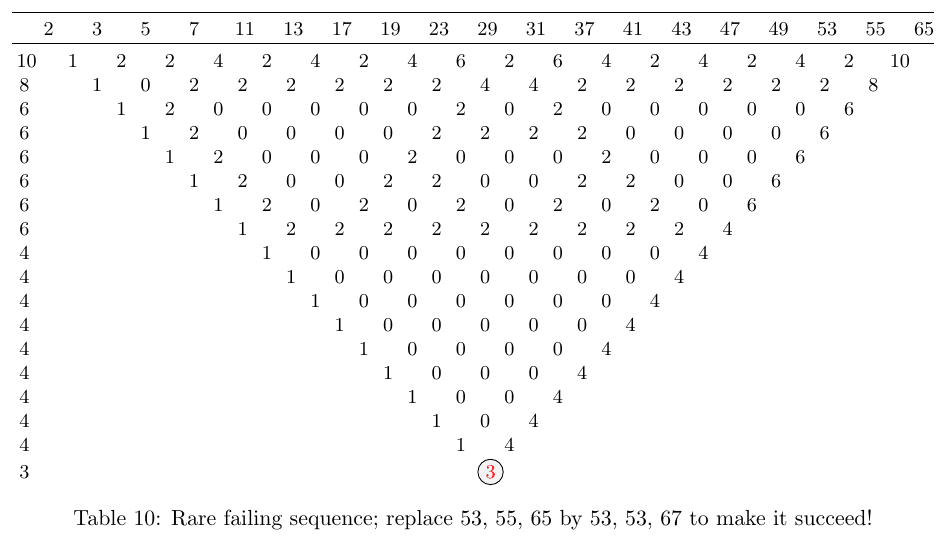
If you look at the triangle, the top row features the prime numbers, with a few changes at the right end. If it consisted of the successive prime numbers only, all the numbers on the left diagonal would be 1, leading to success. The small changes resulted in failure: a number other than 1 at the bottom. This curious phenomenon is a famous unsolved math mystery dating back to 1878, known as Gilbreath's conjecture. Interestingly, it is connected to dynamical systems, cellular automata and xoroshiro, one of the most efficient random generators (see bottom picture). More on these topics in my paper. The triangle is constructed from top to bottom via successive differences in absolute value.
The paper features the most comprehensive and recent research on the subject. I currently collaborate with a student of Terence Tao (the most famous living mathematician) to bring it to the next level. But for you, the interesting part is the numerous and unexpected enterprise applications, even for time-continuous processes such as Brownian motions, a new type of chaos with modeling, synthesis and measurement, or hidden/weak pattern detection. The "failures" and "successes" have intriguing, profound analogies with credit card fraud detection, including the use of synthetic data to generate rich datasets featuring cases of fraud unseen in real data.
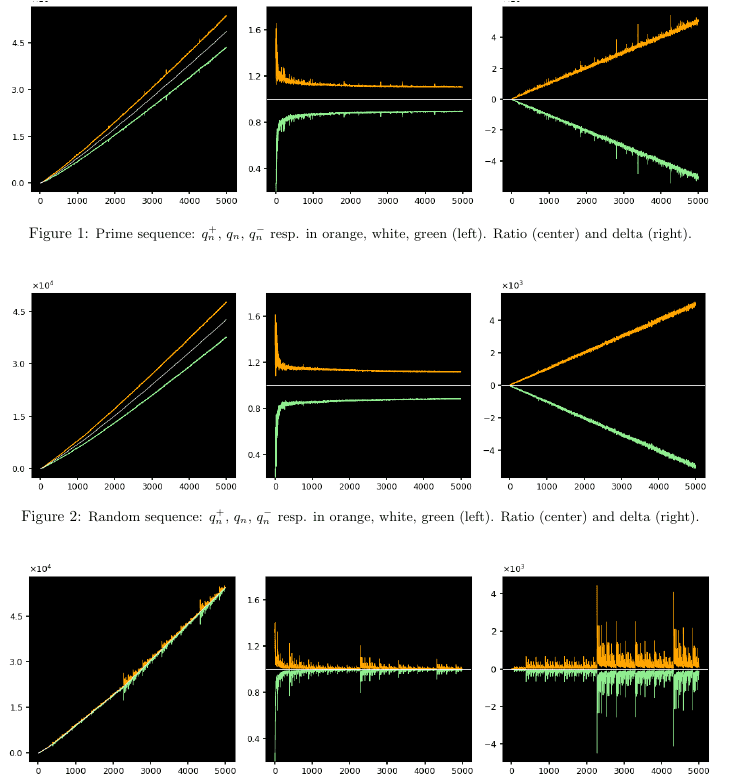
Download the full paper, here. It is now part of my new book (chapter 9), which you can access and download from here. Section 5 focuses on the applications. If you are interested in pure number theory rather than applications, there is a lot of exciting material for you too: magic primes, reverse sieving, and forbidden prime number constellations. The last topic furthers the analogy with rule-based systems for fraud detection. All the figures shared here are explained in detail in the paper, which also features high-performance computing with new computer science algorithms not found anywhere else.

Not only that, but also other enterprise solutions including cybersecurity, Fintech, data synthesis and auditing.
If you look at the triangle, the top row features the prime numbers, with a few changes at the right end. If it consisted of the successive prime numbers only, all the numbers on the left diagonal would be 1, leading to success. The small changes resulted in failure: a number other than 1 at the bottom. This curious phenomenon is a famous unsolved math mystery dating back to 1878, known as Gilbreath's conjecture. Interestingly, it is connected to dynamical systems, cellular automata and xoroshiro, one of the most efficient random generators (see bottom picture). More on these topics in my paper. The triangle is constructed from top to bottom via successive differences in absolute value.
The paper features the most comprehensive and recent research on the subject. I currently collaborate with a student of Terence Tao (the most famous living mathematician) to bring it to the next level. But for you, the interesting part is the numerous and unexpected enterprise applications, even for time-continuous processes such as Brownian motions, a new type of chaos with modeling, synthesis and measurement, or hidden/weak pattern detection. The "failures" and "successes" have intriguing, profound analogies with credit card fraud detection, including the use of synthetic data to generate rich datasets featuring cases of fraud unseen in real data.
Download the full paper, here. It is now part of my new book (chapter 9), which you can access and download from here. Section 5 focuses on the applications. If you are interested in pure number theory rather than applications, there is a lot of exciting material for you too: magic primes, reverse sieving, and forbidden prime number constellations. The last topic furthers the analogy with rule-based systems for fraud detection. All the figures shared here are explained in detail in the paper, which also features high-performance computing with new computer science algorithms not found anywhere else.
About the Author

Vincent Granville is a pioneering AI builder, co-founder at Data Science Central (acquired by TechTarget), co-founder and CAIO at Bonding AI, author, patent owner, expert witness and investor including Limited Partner at CalculusVC, a Bay Area VC firm. Vincent worked with Visa, Wells Fargo, eBay, NBC, Microsoft, CNET and several startups. He is also a top AI influencer for NVIDIA and other brands. His AI newsletter has 200,000 subscribers.
Vincent is a former post-doc at University of Cambridge. He published in Journal of Number Theory, Journal of the Royal Statistical Society (Series B), and IEEE Transactions on Pattern Analysis and Machine Intelligence (500+ citations). He is the author of multiple books, available here, including "Synthetic Data and Generative AI" (Elsevier, 2024). Vincent lives in Washington state, and enjoys doing research on stochastic processes, dynamical systems, probabilistic and computational number theory.
Vincent Granville is a pioneering AI builder, co-founder at Data Science Central (acquired by TechTarget), co-founder and CAIO at Bonding AI, author, patent owner, expert witness and investor including Limited Partner at CalculusVC, a Bay Area VC firm. Vincent worked with Visa, Wells Fargo, eBay, NBC, Microsoft, CNET and several startups. He is also a top AI influencer for NVIDIA and other brands. His AI newsletter has 200,000 subscribers.
Vincent is a former post-doc at University of Cambridge. He published in Journal of Number Theory, Journal of the Royal Statistical Society (Series B), and IEEE Transactions on Pattern Analysis and Machine Intelligence (500+ citations). He is the author of multiple books, available here, including "Synthetic Data and Generative AI" (Elsevier, 2024). Vincent lives in Washington state, and enjoys doing research on stochastic processes, dynamical systems, probabilistic and computational number theory.
More enterprise AI insights
More enterprise AI insights
Stay informed. Leave your email to receive exclusive content and helpful resources.
Stay informed. Leave your email to receive exclusive content and helpful resources.
Recent Articles
Recent Articles

AI Token Costs: Context Windows, Pricing and Audit Trails
AI Token Costs: Context Windows, Pricing and Audit Trails
AI Token Costs: Context Windows, Pricing and Audit Trails

LLM Explainability: How Tokenization Limits AI Traceability
LLM Explainability: How Tokenization Limits AI Traceability
LLM Explainability: How Tokenization Limits AI Traceability

AI Sprawl: Why Most Companies Can't See What Their AI Does
AI Sprawl: Why Most Companies Can't See What Their AI Does
AI Sprawl: Why Most Companies Can't See What Their AI Does

Enterprise AI Costs: Why Companies Are Paying Twice
Enterprise AI Costs: Why Companies Are Paying Twice
Enterprise AI Costs: Why Companies Are Paying Twice

Numbers Every CISO Should Know Before the Next AI Deployment
Numbers Every CISO Should Know Before the Next AI Deployment
Numbers Every CISO Should Know Before the Next AI Deployment

AI Myths Enterprise Leaders Still Believe
AI Myths Enterprise Leaders Still Believe
AI Myths Enterprise Leaders Still Believe

The AI Operating System for Enterprises
300 Davis St, McKinney, TX 75069 - U.S.
© 2026 Copyright - bondingAI.
The AI Operating System for Enterprises
300 Davis St, McKinney, TX 75069 - U.S.
© 2026 Copyright - bondingAI.
The AI Operating System for Enterprises
300 Davis St, McKinney, TX 75069 - U.S.
© 2026 Copyright - bondingAI.
The AI Operating System for Enterprises
300 Davis St, McKinney, TX 75069 - U.S.
© 2026 Copyright - bondingAI.