
Why Deterministic AI May Be the Missing Link in Post-Quantum Cryptography Migration
Why Deterministic AI May Be the Missing Link in Post-Quantum Cryptography Migration

Conformance and known-answer testing. NIST publishes known-answer test vectors for ML-KEM and ML-DSA. Validating an implementation against those vectors needs deterministic pass/fail logic, not probabilistic judgment — this is really a correctness check, and it's one of the few places in the whole pipeline where "deterministic" isn't optional.
Risk-based prioritization at scale. Large organizations have thousands of systems to triage for "harvest now, decrypt later" exposure — data sensitivity, retention period, current algorithm, and exposure surface combine into a priority score. Doing this with a fixed, auditable scoring function rather than an LLM's contextual judgment means two analysts (or two runs six months apart) get the same answer, which matters when the prioritization decision itself gets audited by a regulator or board.
The migration to quantum-safe cryptography is not merely a technical upgrade—it is a governance challenge. Organizations must demonstrate that cryptographic decisions are aligned with risk management frameworks, regulatory obligations, and business objectives. Deterministic AI provides a transparent decision engine that enables security, compliance, legal, and business stakeholders to operate from a common source of truth. By embedding governance directly into the migration process, enterprises can reduce implementation risk while accelerating adoption of quantum-resistant technologies.
The organizations that begin preparing today will be best positioned to protect sensitive data from both current and future threats, including "harvest now, decrypt later" attacks. Post-quantum migration will require unprecedented coordination across technology, security, and governance functions. Deterministic AI offers a path forward—transforming a complex, enterprise-wide cryptographic transition into a structured, auditable, and explainable program that organizations can execute with confidence.
Certificate and key lifecycle automation. Tracking expiry, dependency chains, and rotation schedules across a hybrid (classical + PQC) certificate fleet is fundamentally bookkeeping with hard rules, where deterministic state machines outperform anything generative.
The general pattern: anywhere the output needs to be independently re-derivable, formally checkable, or defensible to an auditor or regulator (NIST, CISA, NSA's CNSA 2.0 timeline compliance), deterministic systems are the right tool. Generative AI still has a place in this migration — drafting documentation, summarizing scan results for stakeholders, explaining a risk report in plain language — but it should sit at the edges of the workflow, not inside the parts that decide what cryptographic code actually gets shipped.
How is your organization approaching cryptographic inventory and quantum-readiness planning? Are you relying on manual discovery processes, or exploring AI-driven approaches to accelerate migration?
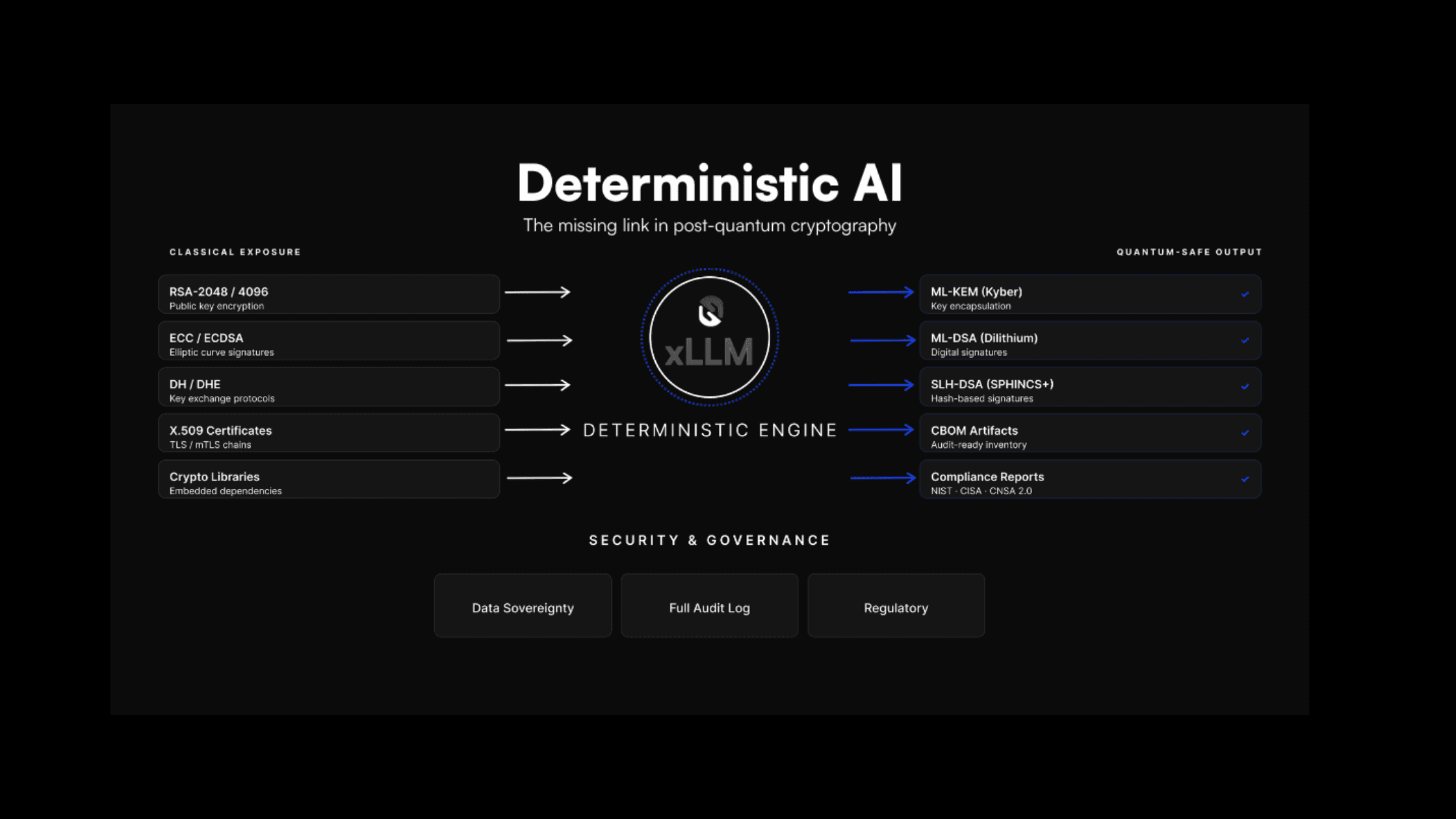
bondingAI is built on exactly this principle.
Our Enterprise AI Operating System delivers deterministic, explainable, and auditable AI workflows purpose-built for regulated industries, giving security and compliance teams the governance controls that they need to act with confidence.
If your organization is beginning to map its quantum-readiness journey, we'd like to show you how bondingAI can turn that complexity into a structured, traceable program.
Conformance and known-answer testing. NIST publishes known-answer test vectors for ML-KEM and ML-DSA. Validating an implementation against those vectors needs deterministic pass/fail logic, not probabilistic judgment — this is really a correctness check, and it's one of the few places in the whole pipeline where "deterministic" isn't optional.
Risk-based prioritization at scale. Large organizations have thousands of systems to triage for "harvest now, decrypt later" exposure — data sensitivity, retention period, current algorithm, and exposure surface combine into a priority score. Doing this with a fixed, auditable scoring function rather than an LLM's contextual judgment means two analysts (or two runs six months apart) get the same answer, which matters when the prioritization decision itself gets audited by a regulator or board.
The migration to quantum-safe cryptography is not merely a technical upgrade—it is a governance challenge. Organizations must demonstrate that cryptographic decisions are aligned with risk management frameworks, regulatory obligations, and business objectives. Deterministic AI provides a transparent decision engine that enables security, compliance, legal, and business stakeholders to operate from a common source of truth. By embedding governance directly into the migration process, enterprises can reduce implementation risk while accelerating adoption of quantum-resistant technologies.
The organizations that begin preparing today will be best positioned to protect sensitive data from both current and future threats, including "harvest now, decrypt later" attacks. Post-quantum migration will require unprecedented coordination across technology, security, and governance functions. Deterministic AI offers a path forward—transforming a complex, enterprise-wide cryptographic transition into a structured, auditable, and explainable program that organizations can execute with confidence.
Certificate and key lifecycle automation. Tracking expiry, dependency chains, and rotation schedules across a hybrid (classical + PQC) certificate fleet is fundamentally bookkeeping with hard rules, where deterministic state machines outperform anything generative.
The general pattern: anywhere the output needs to be independently re-derivable, formally checkable, or defensible to an auditor or regulator (NIST, CISA, NSA's CNSA 2.0 timeline compliance), deterministic systems are the right tool. Generative AI still has a place in this migration — drafting documentation, summarizing scan results for stakeholders, explaining a risk report in plain language — but it should sit at the edges of the workflow, not inside the parts that decide what cryptographic code actually gets shipped.
How is your organization approaching cryptographic inventory and quantum-readiness planning? Are you relying on manual discovery processes, or exploring AI-driven approaches to accelerate migration?
bondingAI is built on exactly this principle.
Our Enterprise AI Operating System delivers deterministic, explainable, and auditable AI workflows purpose-built for regulated industries, giving security and compliance teams the governance controls that they need to act with confidence.
If your organization is beginning to map its quantum-readiness journey, we'd like to show you how bondingAI can turn that complexity into a structured, traceable program.
More enterprise AI insights
More enterprise AI insights
Stay informed. Leave your email to receive exclusive content and helpful resources.
Stay informed. Leave your email to receive exclusive content and helpful resources.
Recent Articles
Recent Articles

AI Sprawl: Why Most Companies Can't See What Their AI Does
AI Sprawl: Why Most Companies Can't See What Their AI Does
AI Sprawl: Why Most Companies Can't See What Their AI Does

Enterprise AI Costs: Why Companies Are Paying Twice
Enterprise AI Costs: Why Companies Are Paying Twice
Enterprise AI Costs: Why Companies Are Paying Twice

Numbers Every CISO Should Know Before the Next AI Deployment
Numbers Every CISO Should Know Before the Next AI Deployment
Numbers Every CISO Should Know Before the Next AI Deployment

AI Myths Enterprise Leaders Still Believe
AI Myths Enterprise Leaders Still Believe
AI Myths Enterprise Leaders Still Believe

Numbers Every CRO Should Know
Numbers Every CRO Should Know
Numbers Every CRO Should Know

Why Generic AI Tools Don't Understand Your Business
Why Generic AI Tools Don't Understand Your Business
Why Generic AI Tools Don't Understand Your Business

The AI Operating System for Enterprises
300 Davis St, McKinney, TX 75069 - U.S.
© 2026 Copyright - bondingAI.
The AI Operating System for Enterprises
300 Davis St, McKinney, TX 75069 - U.S.
© 2026 Copyright - bondingAI.
The AI Operating System for Enterprises
300 Davis St, McKinney, TX 75069 - U.S.
© 2026 Copyright - bondingAI.
The AI Operating System for Enterprises
300 Davis St, McKinney, TX 75069 - U.S.
© 2026 Copyright - bondingAI.