
Deterministic AI Outputs: Why It Matters More Than Accuracy in Regulated Industries
Deterministic AI Outputs: Why It Matters More Than Accuracy in Regulated Industries

Most enterprise AI conversations start with accuracy. But in regulated industries, accuracy is the wrong starting point.
The right question is determinism! And the difference between the two is not semantic. It is the difference between an AI system you can govern and one that will eventually govern you.
The Problem With "Getting It Right Most of the Time"
An AI system that is occasionally wrong is manageable. An AI system that is wrong without warning, without trace, and without explanation is not an asset. It is a liability you cannot audit.
This is what separates probabilistic AI from deterministic AI, and it is the distinction that regulated industries can no longer afford to ignore.
What the 2025 Data Is Telling Us
The risk is not theoretical.
51% of organizations have already reported at least one AI incident. Governance is the clearest factor separating high performers from laggards. (McKinsey State of AI, 2025)
$67.4B: the global cost of AI hallucinations in 2024, growing as adoption accelerates. Not because AI was uncertain. Because it was confidently wrong. (AllAboutAI Hallucination Report, 2025)
$4.44M: average cost of a corporate data breach in 2025. When ungoverned AI tools are involved, add another $670K on top. (IBM Cost of a Data Breach Report, 2025)
76% of organizations now plan to adopt ISO 42001 as their AI governance backbone. The EU AI Act is phasing in through 2026. 24 US states already enforce NAIC AI governance standards. (ISO/AI Governance Survey, 2025 · NAIC, 2025)
The regulatory environment has shifted. Enterprises still running ungoverned probabilistic AI are operating on borrowed time.
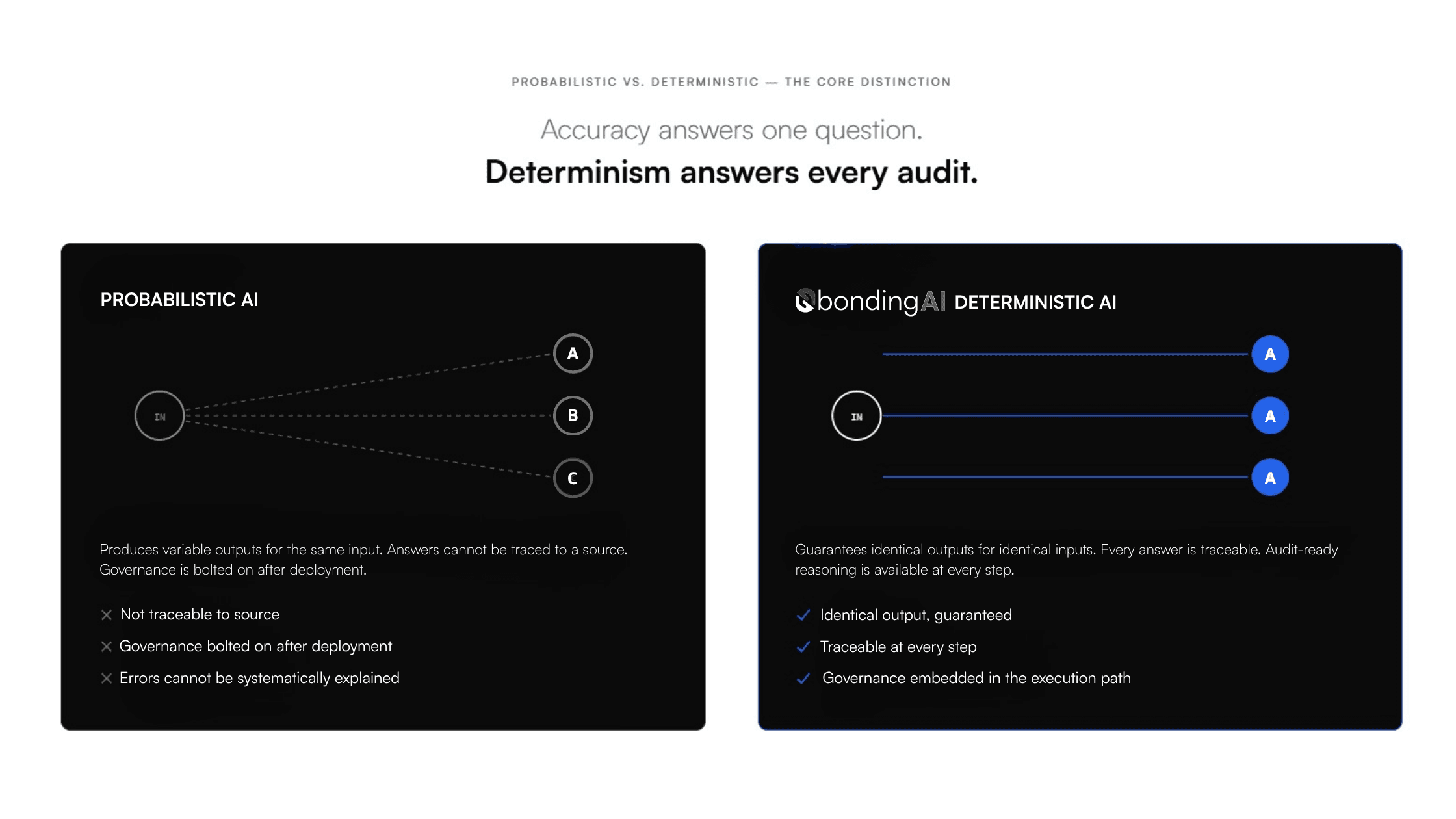
Probabilistic vs. Deterministic: The Core Distinction
Accuracy answers one question.
Determinism answers every audit.
Probabilistic AI produces variable outputs for the same input. Answers cannot be traced to a source. Governance is bolted on after deployment. When errors occur, they cannot be systematically explained.
Deterministic AI guarantees identical outputs for identical inputs. Every answer is traceable. Audit-ready reasoning is available at every step. Governance is embedded in the execution path, not added on top of it.
What This Looks Like Across Regulated Verticals
Financial services & insurance: Auditors do not accept statistical probability as a decision explanation. They require traceable, reproducible reasoning. An AI that cannot provide it is a compliance risk, not a productivity tool.
Healthcare & life sciences: Variable outputs for identical patient profiles are a patient safety issue and a regulatory failure. Under the EU AI Act, deterministic explainability is not a preference. It is the baseline.
Legal & government: Stanford RegLab found that public AI tools produced incorrect outputs on legal queries between 69% and 88% of the time. In legal environments, a hallucinated output does not get corrected. It gets filed.
The bondingAI Approach
bondingAI was built for enterprises that operate where errors have consequences.
At the core of the bondingAI AI Operating System is xLLM - the Enterprise Language Model. Deterministic by architecture, not by configuration. Same input, same output, every time.
White-box reasoning: every answer traceable to its source, audit-ready for compliance teams and regulators.
Private infrastructure: data never leaves your controlled environment.
Governed agentic workflows: AI agents executing across CRM, ERP, and data systems under zero-trust guardrails
Governance Is the Competitive Advantage
The enterprises that will lead with AI in regulated industries are not the ones that moved faster. They are the ones that govern best.
When AI outputs are non-deterministic, the consequences are not reversible.
bondingAI is the only AI Operating System purpose-built for enterprises where deterministic outputs, explainability, and audit-ready governance are non-negotiable.
Sources
McKinsey State of AI, 2025
AllAboutAI Hallucination Report, 2025
IBM Cost of a Data Breach Report, 2025
ISO/AI Governance Survey, 2025
NAIC Model Bulletin on AI Governance, March 2025
Stanford RegLab, Legal AI Accuracy Study, 2024
EU AI Act Implementation Timeline, 2024–2026
Want to understand how bondingAI's xLLM engine delivers deterministic AI for your regulated environment? Get in touch with our enterprise team.
Most enterprise AI conversations start with accuracy. But in regulated industries, accuracy is the wrong starting point.
The right question is determinism! And the difference between the two is not semantic. It is the difference between an AI system you can govern and one that will eventually govern you.
The Problem With "Getting It Right Most of the Time"
An AI system that is occasionally wrong is manageable. An AI system that is wrong without warning, without trace, and without explanation is not an asset. It is a liability you cannot audit.
This is what separates probabilistic AI from deterministic AI, and it is the distinction that regulated industries can no longer afford to ignore.
What the 2025 Data Is Telling Us
The risk is not theoretical.
51% of organizations have already reported at least one AI incident. Governance is the clearest factor separating high performers from laggards. (McKinsey State of AI, 2025)
$67.4B: the global cost of AI hallucinations in 2024, growing as adoption accelerates. Not because AI was uncertain. Because it was confidently wrong. (AllAboutAI Hallucination Report, 2025)
$4.44M: average cost of a corporate data breach in 2025. When ungoverned AI tools are involved, add another $670K on top. (IBM Cost of a Data Breach Report, 2025)
76% of organizations now plan to adopt ISO 42001 as their AI governance backbone. The EU AI Act is phasing in through 2026. 24 US states already enforce NAIC AI governance standards. (ISO/AI Governance Survey, 2025 · NAIC, 2025)
The regulatory environment has shifted. Enterprises still running ungoverned probabilistic AI are operating on borrowed time.
Probabilistic vs. Deterministic: The Core Distinction
Accuracy answers one question.
Determinism answers every audit.
Probabilistic AI produces variable outputs for the same input. Answers cannot be traced to a source. Governance is bolted on after deployment. When errors occur, they cannot be systematically explained.
Deterministic AI guarantees identical outputs for identical inputs. Every answer is traceable. Audit-ready reasoning is available at every step. Governance is embedded in the execution path, not added on top of it.
What This Looks Like Across Regulated Verticals
Financial services & insurance: Auditors do not accept statistical probability as a decision explanation. They require traceable, reproducible reasoning. An AI that cannot provide it is a compliance risk, not a productivity tool.
Healthcare & life sciences: Variable outputs for identical patient profiles are a patient safety issue and a regulatory failure. Under the EU AI Act, deterministic explainability is not a preference. It is the baseline.
Legal & government: Stanford RegLab found that public AI tools produced incorrect outputs on legal queries between 69% and 88% of the time. In legal environments, a hallucinated output does not get corrected. It gets filed.
The bondingAI Approach
bondingAI was built for enterprises that operate where errors have consequences.
At the core of the bondingAI AI Operating System is xLLM - the Enterprise Language Model. Deterministic by architecture, not by configuration. Same input, same output, every time.
White-box reasoning: every answer traceable to its source, audit-ready for compliance teams and regulators.
Private infrastructure: data never leaves your controlled environment.
Governed agentic workflows: AI agents executing across CRM, ERP, and data systems under zero-trust guardrails
Governance Is the Competitive Advantage
The enterprises that will lead with AI in regulated industries are not the ones that moved faster. They are the ones that govern best.
When AI outputs are non-deterministic, the consequences are not reversible.
bondingAI is the only AI Operating System purpose-built for enterprises where deterministic outputs, explainability, and audit-ready governance are non-negotiable.
Sources
McKinsey State of AI, 2025
AllAboutAI Hallucination Report, 2025
IBM Cost of a Data Breach Report, 2025
ISO/AI Governance Survey, 2025
NAIC Model Bulletin on AI Governance, March 2025
Stanford RegLab, Legal AI Accuracy Study, 2024
EU AI Act Implementation Timeline, 2024–2026
Want to understand how bondingAI's xLLM engine delivers deterministic AI for your regulated environment? Get in touch with our enterprise team.
More enterprise AI insights
More enterprise AI insights
Stay informed. Leave your email to receive exclusive content and helpful resources.
Stay informed. Leave your email to receive exclusive content and helpful resources.
Recent Articles
Recent Articles

AI Sprawl: Why Most Companies Can't See What Their AI Does
AI Sprawl: Why Most Companies Can't See What Their AI Does
AI Sprawl: Why Most Companies Can't See What Their AI Does

Enterprise AI Costs: Why Companies Are Paying Twice
Enterprise AI Costs: Why Companies Are Paying Twice
Enterprise AI Costs: Why Companies Are Paying Twice

Numbers Every CISO Should Know Before the Next AI Deployment
Numbers Every CISO Should Know Before the Next AI Deployment
Numbers Every CISO Should Know Before the Next AI Deployment

AI Myths Enterprise Leaders Still Believe
AI Myths Enterprise Leaders Still Believe
AI Myths Enterprise Leaders Still Believe

Numbers Every CRO Should Know
Numbers Every CRO Should Know
Numbers Every CRO Should Know

Why Generic AI Tools Don't Understand Your Business
Why Generic AI Tools Don't Understand Your Business
Why Generic AI Tools Don't Understand Your Business

The AI Operating System for Enterprises
300 Davis St, McKinney, TX 75069 - U.S.
© 2026 Copyright - bondingAI.
The AI Operating System for Enterprises
300 Davis St, McKinney, TX 75069 - U.S.
© 2026 Copyright - bondingAI.
The AI Operating System for Enterprises
300 Davis St, McKinney, TX 75069 - U.S.
© 2026 Copyright - bondingAI.
The AI Operating System for Enterprises
300 Davis St, McKinney, TX 75069 - U.S.
© 2026 Copyright - bondingAI.