
The AI Bill Nobody Planned For | Enterprise AI Costs
The AI Bill Nobody Planned For | Enterprise AI Costs

The AI Bill Nobody Planned For
Why Enterprises Are Rationing AI and What to Do Before It Happens to You
The era of unchecked AI spending is over.
Uber burned through its entire 2026 AI budget in four months. Microsoft canceled Claude Code licenses. A senior executive at a major financial firm summed it up plainly: "The free-money period for AI is definitively over." (WSJ, May 2026)
This isn't a cautionary tale about one company moving too fast. It's a structural shift playing out across the enterprise market and it's accelerating.
The Spending Problem Nobody Saw Coming
When AI tools became widely available, the prevailing enterprise strategy was simple: adopt fast, experiment broadly, and figure out the ROI later. Leaders encouraged staff to use AI tools "as much as possible." Internal leaderboards tracked AI usage. Budgets were open-ended.
The results were predictable — in hindsight.
According to Gartner, enterprise AI agent spending is projected to reach $207 billion in 2026, up 139% year-over-year. Yet according to Bain, 63% of organizations say AI costs have already exceeded their initial projections. (Bain, May 2026)
Leaders who encouraged unrestricted AI experimentation are now scrambling to ration access, redirect staff to cheaper alternatives, and justify every token spent. (WSJ / The Media Copilot, June 2026)
A Case Study the Market Can't Ignore
In April 2026, Uber's CTO revealed that the company had exhausted 100% of its annual AI budget in just four months. The disclosure went viral, and for good reason.
What followed was what SVP, Andrew Macdonald described as a "head-exploding moment" inside the company. Leadership was forced to confront an uncomfortable question: were all those tokens actually producing better consumer outcomes?
Macdonald's answer was stark: "That link is not there yet."
Uber's response was reactive: a $1,500/month cap per employee on AI coding tools. A spending limit as a substitute for governance.
Uber is not alone. Microsoft, Duolingo, and others have publicly questioned whether token volume translates to business outcomes. This is no longer an isolated incident, it's a pattern.
(Sources: Bloomberg, TechCrunch, Fortune, Business Insider — May–June 2026)
The Token Trap
At the root of this problem, there’s a fundamental misalignment between how enterprises measure AI usage and what their boards actually want.
What enterprises measured:
Tokens consumed
Prompts sent
Agents deployed
Tools activated
What boards actually want:
Revenue generated
Costs reduced
Features shipped faster
Risk mitigated
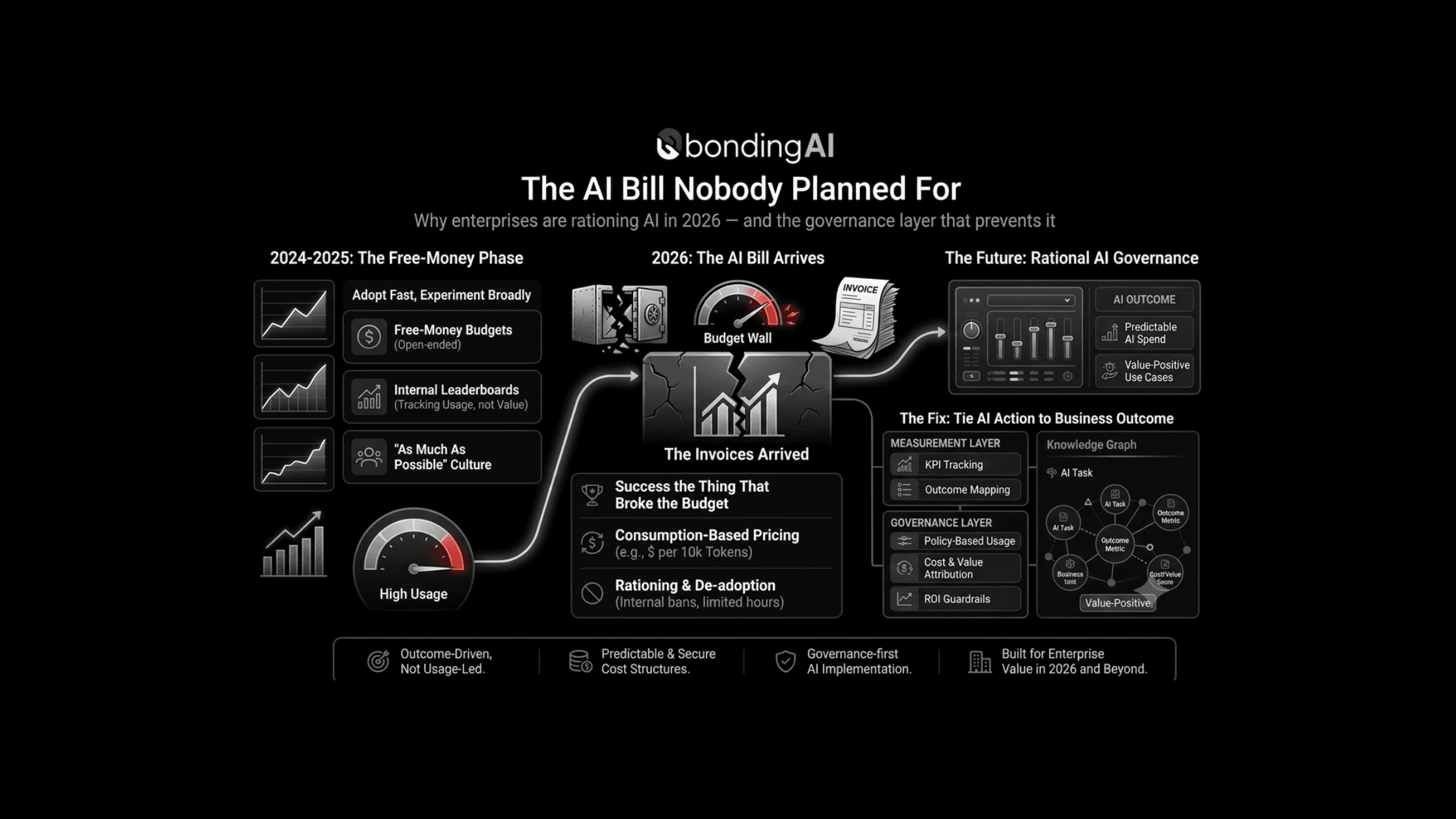
This misalignment has a name: tokenmaxxing — the pursuit of maximum AI consumption without clear connection to business outcomes. And the market is now in full backlash mode.
70% of enterprises say tool sprawl is actively limiting their AI integration (Zapier / Centiment, 2025). Shadow AI reduces ROI on approved tools by up to 56% (Second Talent, 2026).
The issue isn't AI itself. It's the absence of a governance layer around it.
What Enterprises Are Actually Missing
The AI cost problem is a governance problem.
Most enterprises today run more than a dozen AI tools across their organization. IT is aware of only a fraction of them. Subscriptions multiply across teams. Shadow AI spreads unchecked. And when finance asks for a cost-benefit breakdown, nobody has a clean answer.
The bondingAI Approach
bondingAI was built for exactly this moment. Our Enterprise AI Operating System gives organizations what they've been missing: a single platform to centralize AI providers, eliminate redundant platform expenses, and connect every AI action to a measurable business outcome, with deterministic, auditable results at every step.
Without bondingAI:
Multiple AI tools, zero centralized visibility.
Budgets exhausted before Q2.
Shadow AI spreading across teams.
No traceable link between AI spend and outcomes.
With bondingAI:
One centralized AI platform.
Real-time cost visibility and controls.
Built-in governance and compliance layer.
Deterministic, auditable ROI.
Ready to Stop Paying for AI Chaos?
If your organization is navigating AI cost sprawl, tool proliferation, or growing pressure from finance and compliance teams to justify AI investments, we'd like to help.
Talk to a bondingAI specialist and see how enterprises are taking back control of their AI spend.
Sources
Gartner (2026) · Bain (May 2026) · WSJ (May 2026) · The Media Copilot / Pete Pachal (June 1, 2026) · TechCrunch (June 2, 2026) · Bloomberg · Fortune · Business Insider (May–June 2026) · Zapier / Centiment (2025) · Second Talent (2026)
Schedule a conversation with our team!
The AI Bill Nobody Planned For
Why Enterprises Are Rationing AI and What to Do Before It Happens to You
The era of unchecked AI spending is over.
Uber burned through its entire 2026 AI budget in four months. Microsoft canceled Claude Code licenses. A senior executive at a major financial firm summed it up plainly: "The free-money period for AI is definitively over." (WSJ, May 2026)
This isn't a cautionary tale about one company moving too fast. It's a structural shift playing out across the enterprise market and it's accelerating.
The Spending Problem Nobody Saw Coming
When AI tools became widely available, the prevailing enterprise strategy was simple: adopt fast, experiment broadly, and figure out the ROI later. Leaders encouraged staff to use AI tools "as much as possible." Internal leaderboards tracked AI usage. Budgets were open-ended.
The results were predictable — in hindsight.
According to Gartner, enterprise AI agent spending is projected to reach $207 billion in 2026, up 139% year-over-year. Yet according to Bain, 63% of organizations say AI costs have already exceeded their initial projections. (Bain, May 2026)
Leaders who encouraged unrestricted AI experimentation are now scrambling to ration access, redirect staff to cheaper alternatives, and justify every token spent. (WSJ / The Media Copilot, June 2026)
A Case Study the Market Can't Ignore
In April 2026, Uber's CTO revealed that the company had exhausted 100% of its annual AI budget in just four months. The disclosure went viral, and for good reason.
What followed was what SVP, Andrew Macdonald described as a "head-exploding moment" inside the company. Leadership was forced to confront an uncomfortable question: were all those tokens actually producing better consumer outcomes?
Macdonald's answer was stark: "That link is not there yet."
Uber's response was reactive: a $1,500/month cap per employee on AI coding tools. A spending limit as a substitute for governance.
Uber is not alone. Microsoft, Duolingo, and others have publicly questioned whether token volume translates to business outcomes. This is no longer an isolated incident, it's a pattern.
(Sources: Bloomberg, TechCrunch, Fortune, Business Insider — May–June 2026)
The Token Trap
At the root of this problem, there’s a fundamental misalignment between how enterprises measure AI usage and what their boards actually want.
What enterprises measured:
Tokens consumed
Prompts sent
Agents deployed
Tools activated
What boards actually want:
Revenue generated
Costs reduced
Features shipped faster
Risk mitigated
This misalignment has a name: tokenmaxxing — the pursuit of maximum AI consumption without clear connection to business outcomes. And the market is now in full backlash mode.
70% of enterprises say tool sprawl is actively limiting their AI integration (Zapier / Centiment, 2025). Shadow AI reduces ROI on approved tools by up to 56% (Second Talent, 2026).
The issue isn't AI itself. It's the absence of a governance layer around it.
What Enterprises Are Actually Missing
The AI cost problem is a governance problem.
Most enterprises today run more than a dozen AI tools across their organization. IT is aware of only a fraction of them. Subscriptions multiply across teams. Shadow AI spreads unchecked. And when finance asks for a cost-benefit breakdown, nobody has a clean answer.
The bondingAI Approach
bondingAI was built for exactly this moment. Our Enterprise AI Operating System gives organizations what they've been missing: a single platform to centralize AI providers, eliminate redundant platform expenses, and connect every AI action to a measurable business outcome, with deterministic, auditable results at every step.
Without bondingAI:
Multiple AI tools, zero centralized visibility.
Budgets exhausted before Q2.
Shadow AI spreading across teams.
No traceable link between AI spend and outcomes.
With bondingAI:
One centralized AI platform.
Real-time cost visibility and controls.
Built-in governance and compliance layer.
Deterministic, auditable ROI.
Ready to Stop Paying for AI Chaos?
If your organization is navigating AI cost sprawl, tool proliferation, or growing pressure from finance and compliance teams to justify AI investments, we'd like to help.
Talk to a bondingAI specialist and see how enterprises are taking back control of their AI spend.
Sources
Gartner (2026) · Bain (May 2026) · WSJ (May 2026) · The Media Copilot / Pete Pachal (June 1, 2026) · TechCrunch (June 2, 2026) · Bloomberg · Fortune · Business Insider (May–June 2026) · Zapier / Centiment (2025) · Second Talent (2026)
Schedule a conversation with our team!
More enterprise AI insights
More enterprise AI insights
Stay informed. Leave your email to receive exclusive content and helpful resources.
Stay informed. Leave your email to receive exclusive content and helpful resources.
Recent Articles
Recent Articles

AI Sprawl: Why Most Companies Can't See What Their AI Does
AI Sprawl: Why Most Companies Can't See What Their AI Does
AI Sprawl: Why Most Companies Can't See What Their AI Does

Enterprise AI Costs: Why Companies Are Paying Twice
Enterprise AI Costs: Why Companies Are Paying Twice
Enterprise AI Costs: Why Companies Are Paying Twice

Numbers Every CISO Should Know Before the Next AI Deployment
Numbers Every CISO Should Know Before the Next AI Deployment
Numbers Every CISO Should Know Before the Next AI Deployment

AI Myths Enterprise Leaders Still Believe
AI Myths Enterprise Leaders Still Believe
AI Myths Enterprise Leaders Still Believe

Numbers Every CRO Should Know
Numbers Every CRO Should Know
Numbers Every CRO Should Know

Why Generic AI Tools Don't Understand Your Business
Why Generic AI Tools Don't Understand Your Business
Why Generic AI Tools Don't Understand Your Business

The AI Operating System for Enterprises
300 Davis St, McKinney, TX 75069 - U.S.
© 2026 Copyright - bondingAI.
The AI Operating System for Enterprises
300 Davis St, McKinney, TX 75069 - U.S.
© 2026 Copyright - bondingAI.
The AI Operating System for Enterprises
300 Davis St, McKinney, TX 75069 - U.S.
© 2026 Copyright - bondingAI.
The AI Operating System for Enterprises
300 Davis St, McKinney, TX 75069 - U.S.
© 2026 Copyright - bondingAI.